Where Horror Gets Studied, Skewered, and Celebrated.
Newest articles and reviews
(The Horrified Linguist) "They Thought He was Family:" PRIMATE (2025)
By. "Wise Up" Katie Weiss
Every day when I come home, my son (who happens to be a cat) is thrilled to greet me at the door. “Meeeooowww!” he says. “Hi, son!” I gleefully reply. In that moment, we have successfully communicated with one another using each of our own means of doing so. Through his “meeeooowww!”, I am reasonably certain that he is happy that I’m home, and through my “hi son!”, he is reasonably certain that I am happy to see him, too. However, simple messages like these are pretty much the extent of our communication with one another. He lets me know he loves me by sitting on my lap and purring. He lets me know he’s hungry by letting out several loud meows early in the morning. He lets me know he has to go to the restroom by...going to the restroom. But as far as communication goes, that’s about all there is to it because, even though I love my cat-son more than anything in the world, I must face the inevitable: we do not share a language.
Of course, this language barrier between a human and their pet is unavoidable. As much as I would like to talk to Ritchie about how his day went, I cannot really do that, even though we can typically communicate about his immediate needs and feelings. In fact, as most linguists would agree, the following applies across the entire animal kingdom: animals simply do not have the same capacity to learn and use language to the same extent that humans do. However, there are plenty of non-humans who have challenged this idea through the way they communicate. Bees, for example, can let each other know where potential food sources are in relation to their hives, therefore challenging the general view that animals are unable to speak about things that are right in front of them. As cool as this is, bees hardly hold a candle to the communication skills of chimpanzees, especially when it comes to their communication with humans. A chimpanzee named Washoe, for example, learned an impressive amount of sign language and was even able to use those signs to communicate in complex ways that we are simply not used to seeing from animals!
You know who reminds me of Washoe? You guessed it...meet Ben from the new horror film PRIMATE (2025)! Because most linguists and non-linguists alike agree that the communication we share with animals doesn’t truly come close to the language we share with humans, there is an extra layer of warmth when we see animals who share a language, at least to some extent, with their humans. We definitely see that with Ben.
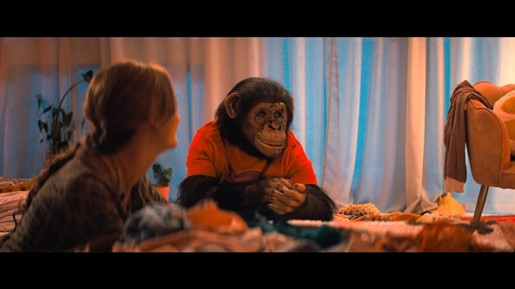
It is undeniable that Ben was very much loved by his humans. Of course, we all really love our pets, don’t we? And, of course, most of us would consider our pets as part of our family, even if they don’t know a single word in a human language. However, it is clear that Ben’s family in particular would not even consider uttering the word “pet” in reference to Ben. In fact, right around the start of Ben’s rampage, Ben’s oldest sister Lucy (Johnny Sequoyah) was absolutely horrified when the party-crashing friend-of-a-friend Hannah (Jess Alexander) told her that Ben needs to be killed, and seemingly just as horrified by the fact that Hannah referred to Ben as a pet in her plea. To Lucy and her family, Ben was not a pet. He was a brother. He was a son. He was a lasting memory of the matriarch of the family who spent much of her linguistics career teaching Ben both languages the family used: English as spoken through his tablet, and American Sign Language as signed with his hands. Language is so deeply and intrinsically part of the human experience, and Ben shared that aspect of the human experience with his family. He had the warmth of a family pet and the intelligence of a human...and that warmth/ intelligence combo did NOT go over very well when he started killing everyone!
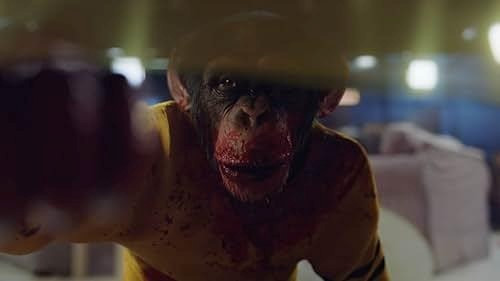
Just like any good father, Adam (Troy Kotsur) deeply loves his family. Even though he apparently travels far too often due to his successful career as an author, it is clear throughout this film that his daughters are an undeniably bright light in his life. In fact, he clearly loves all three of his kids, Ben included! So, imagine his utter horror when he came home to realize that his son's doctor was correct; Ben did, in fact, have rabies, a disease deadly to animals and humans alike. Even worse, while Ben was rabid, he killed human beings and even tried to kill his own family. That’s right—Ben, the remarkable chimpanzee who shared some language with his family—went from his lovable, cuddly self to a rabid monster whose only goal was to kill, kill, kill. He had little to no hesitation as he orchestrated a jaw-ripping, neck-breaking, flesh-tearing murder spree in the home of a family who used to see him as a son and a brother.
Near the end of Ben’s murder spree, he reaches his hand out to his oldest sister as if to say, “I’m sorry. It’s still me. Your little brother is still here.” I am not ashamed to admit that I, like Lucy, was fooled. Perhaps Lucy and I both had wishful thinking that, deep down, Ben was still Ben. But no. After a few seconds of the old Ben, we see that we were wrong. He was no longer a son, a brother, or a friend. He was simply...PRIMATE.
About Professor Horror
At Professor Horror, we don't just watch horror: we live it, study it, and celebrate it. Run by writers, critics, and scholars who've made horror both a passion and a career, our mission is to explore the genre in all its bloody brillance. From big-budget slashers to underground gems, foreign nightmares to literary terrors, we dig into what makes horror tick (and why it sticks with us). We believe horror is more than just entertainment; it's a mirror, a confession, and a survival story. And we care deeply about the people who make it, love it, and keep it alive.